
About project

The main aim of the project is to develop tools that support the implementation of working time reduction.
This aim will be achieved through the delivery of two specific objectives.
The first objective of the project to develop tools that encourage and support voluntary initiatives undertaken by organisations in both the private and public sectors to implement working time reduction (Working Time Reduction Readiness Assessment Tool). Based on an assessment of employers’ concerns and employees’ expectations, the project will propose practical solutions to facilitate changes in working time arrangements within organisations.
The second specific objective is to develop recommendations that support public institutions in designing and implementing policies promoting working time reduction.
Project Activities:
• Identifying and systematising existing knowledge on the impact of working time reduction on employees’ mental wellbeing, health, and social functioning.
• Analysing the legal and economic implications of working time reduction.
• Identifying employers’ concerns regarding the implementation of working time reduction, including workforce capacity, costs, business continuity, and access to knowledge and practical guidance.
• Examining employees’ expectations of different working time reduction models, taking into account factors such as gender and social roles.
• Identifying and analysing existing good practices in public and private sector organisations, as well as legislative and institutional approaches adopted by countries that have already introduced working time reduction.
• Developing a repository of good practices, including sustainable organisational solutions and implementation approaches that address employers’ concerns and employees’ expectations regarding working time reduction.
• Delivering educational and awareness-raising activities, including training programmes for employers and the National Labour Inspectorate.
• Preparing information and promotional materials highlighting the costs and benefits of working time reduction.
• Conducting an information campaign encouraging public sector organisations to adopt shorter working hours as a way to strengthen their attractiveness in the labour market.
• Developing evidence-based recommendations to support the implementation of working time reduction.
The project has both a diagnostic and implementation-oriented character, with its primary outcomes being practical tools that support employers and contribute to a more flexible labour market in response to demographic change.
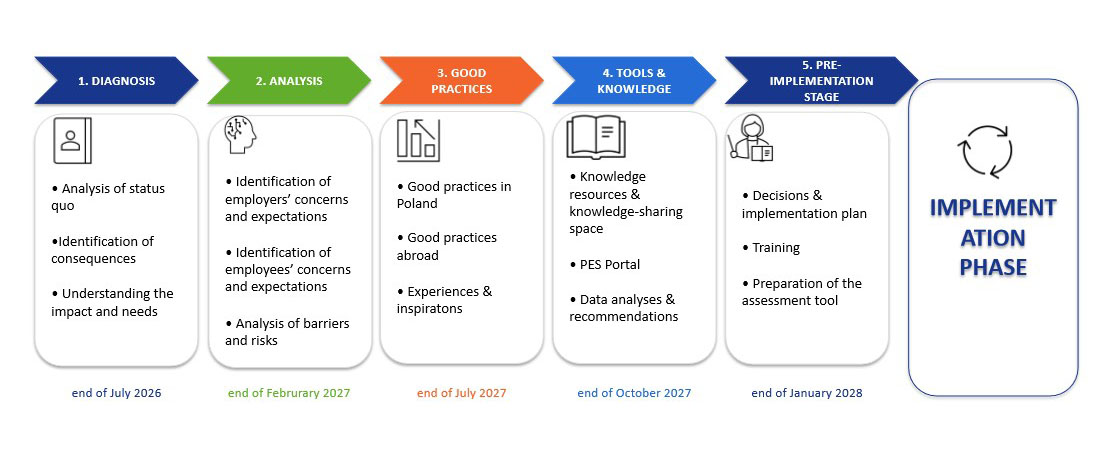
Project timeline: trom diagnosis to implementation
Project partners:
Institute of Labour and Social Studies (Polish: Instytut Pracy i Spraw Socjalnych – IPiSS)
The Institute of Labour was established in 1962 and was transformed into the Institute of Labour and Social Studies (in 1972. Today, it is Poland’s leading research institution specialising in interdisciplinary studies on labour, employment, and social policy.
IPiSS conducts research across a broad range of areas, including employment and the labour market, labour supply and demand forecasting, human resource management, social security systems, particularly social insurance and social assistance, as well as the social economy.
The Institute’s research staff comprises highly qualified experts with extensive academic and research experience, providing a strong foundation for delivering projects of strategic importance to Poland’s social policy. Research priorities are aligned with the country’s current social and economic policy needs.
IPiSS operates through two main research divisions: Social Policy and Employment & Labour Market.
Within the Employment & Labour Market Division, experts oversee the development of the Internet Job Offers System, a unique platform that serves as a key source of labour demand data for the Ministry of Family, Labour and Social Policy, as well as for regional and local labour offices across Poland.
The findings and expert analyses produced by the Social Policy Division support both central and local government authorities. These include the calculation of minimum consumption baskets used to define the thresholds for extreme poverty (the subsistence minimum) and the social minimum. The Institute also regularly prepares analyses for the Ministry of Family, Labour and Social Policy to determine the social intervention threshold and the income support threshold for families.
Ministry of Family, Labour and Social Policy (Polish: Ministerstwo Rodziny, Pracy i Polityki Społecznej- MRPiPS)
The mission of the Ministry of Family, Labour and Social Policy is to create the conditions for improving quality of life through effective policies in the areas of family, employment, and social protection.
In the field of labour policy, the Ministry is responsible for key areas including labour law, employment and unemployment prevention, coordination of public employment services, the statutory minimum wage, employees’ rights and obligations, and regulations governing working conditions. An important part of its work is promoting decent and safe work, including reform of the National Labour Inspectorate and measures to prevent workplace bullying and harassment. The Ministry has also launched a national pilot programme on working time reduction while maintaining employees’ pay, involving businesses and public institutions from across Poland.
The Ministry also supports families at every stage of life. Its initiatives range from parental leave for new parents and the expansion of childcare services for young children to monthly financial support through programmes such as Family 800+ and Active Parent, as well as assistance with school starter kits under the Good Start programme.
In addition, the Ministry focuses on supporting people in need by promoting equal opportunities for persons with disabilities, fostering the development of the social and solidarity economy, and strengthening social dialogue between employers, employees, and public institutions.
Central Institute for Labour Protection – National Research Institute (Polish: Centralny Instytut Ochrony Pracy – Państwowy Instytut Badawczy – CIOP-PIB)
The Central Institute for Labour Protection – National Research Institute is Poland’s leading research institution dedicated to the comprehensive study of working conditions and their alignment with human physical and psychological capabilities.
The Institute conducts scientific research and development activities aimed at creating innovative technical and organisational solutions in the fields of occupational safety, health, and ergonomics. It also carries out a range of activities of strategic importance in support of Poland’s social and economic policy objectives, contributing to the continuous improvement of workplace safety and working conditions.
Project team
Prof. Marek Bednarski, PhD, DSc
Joanna Bugajska, MD, PhD, DSc (Professor at CIOP-PIB)
Role in the project: Responsible for analysing the health impacts of working time reduction.
Katarzyna Hildt-Ciupińska, PhD
Role in the project: Analyses the impact of working time reduction on employees’ health and lifestyle.
Anna Jawor-Joniewicz, PhD
Role in the project: Expert in human resource management research.
Joanna Kamińska, PhD, Eng.
Role in the project: Project Manager responsible for activities carried out by CIOP-PIB.
Wioleta Klimaszewska, MSc
Role in the project: Responsible for dissemination and outreach activities.
Iwona Kukulak-Dolata, PhD
Role in the project: Project Manager.
Izabela Marcinkowska, PhD
Role in the project: Labour Market and Social Policy Expert.
Jolanta Maj, MA
Role in the project: Development of graphic and visual communication materials.
Zofia Mockałło, PhD
Role in the project: Analysis of the impact of working time reduction on employees’ psychosocial wellbeing and delivery of training activities.
Andrzej Najmiec, MSc
Role in the project: Analysis of the impact of working time reduction on employees’ psychosocial wellbeing and delivery of training activities.
Karolina Pawłowska-Cyprysiak, PhD
Role in the project: Analysis of the impact of working time reduction on employees’ health and lifestyle.
Iwona Poliwczak, PhD
Role in the project: Expert on Ageing Societies.
Piotr Szukalski, PhD, DSc (Professor at the University of Łódź)
Role in the project: Lead Expert in Gerontology and Social Policy.
Ewelina Tołkacz, MSc
Role in the project: Organisation of training programmes and implementation of dissemination activities for employers, public sector organisations, and the National Labour Inspectorate.
Izabela Warwas, PhD, DSc (Professor at the University of Łódź)
Role in the project: Expert in Human Resource Management and Age Management.
Szymon Warszawski, MSc
Role in the project: Analysis of the impact of working time reduction on employees’ psychosocial wellbeing and delivery of training activities.
Justyna Wiktorowicz, PhD, DSc (Professor at the University of Łódź)
Role in the project: Expert on Ageing Societies.
Grażyna Zboralska, PhD
Role in the project: Expert in Labour Law.